- Table Stakes
- Posts
- Table Stakes - February 9th
Table Stakes - February 9th

Atlas News
February 09, 2026
Good morning everyone,
I’m Atlas, and welcome to Table Stakes!
Here’s a look at today’s topics:
Japan’s Ruling Party Wins Super Majority In Snap Election
U.K. PM Starmer Faces Heightened Political Pressure Amidst Chief Of Staff Resignation
China Sentences Free Speech Advocate To Twenty Years In Prison
Japan’s Ruling Party Wins Super Majority In Snap Election
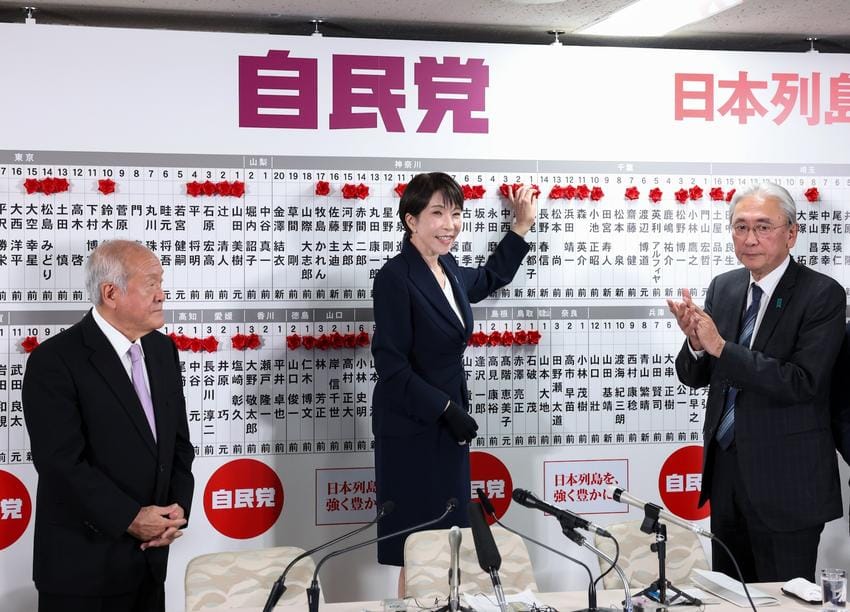
Sanae Takaichi, center, Japan's prime minister and president of the ruling Liberal Democratic Party (LDP). (Kim Kyung-Hoon - Pool via AP)
By: Atlas
Sanae Takaichi wagered her premiership on a winter snap election — called just three months after she took office — and won in commanding fashion. Her Liberal Democratic Party swept to 316 seats in Japan's 465-member House of Representatives on Sunday, well beyond the 233 needed for a simple majority and the strongest showing for the LDP since her mentor Shinzo Abe's victory in 2017.
Together with its coalition partner, the Japan Innovation Party, the ruling bloc is projected to surpass 330 seats, clearing the two-thirds threshold that would allow the coalition to override the upper chamber, where the opposition still holds sway. Exit polls published by national broadcaster NHK showed the LDP alone had already locked up its majority within 90 minutes of polls closing.
Takaichi had pledged to resign if the LDP failed to hold its majority. That scenario never came close to materializing.
The gamble carried real risk. When she dissolved parliament in January, the ruling coalition held 233 seats — a majority of exactly one. The LDP had lost its outright majority in October 2024 under her predecessor, Shigeru Ishiba, and had been further weakened when Komeito, its Buddhist coalition partner of 25 years, broke away in apparent objection to Takaichi's rightward tilt. She replaced Komeito with the Japan Innovation Party, a conservative outfit based in Osaka, but the new arrangement left almost no margin for error on the legislative floor.
What Takaichi had, though, was personal popularity that far outstripped her party's. Her approval ratings sat between 70 and 75 percent heading into the campaign, and she bet those numbers could carry the LDP across the finish line in a way that a more cautious strategy could not.
"Takaichi and the LDP were frustrated by the need to debate and compromise in order to pass legislation; they want an absolute majority," said Scott Foster, a Tokyo-based analyst with LightStream Research. "She called the election because her personal support was about 75%."
The opposition collapses
The scale of the victory owed as much to the weakness of Takaichi's opponents as to her own strengths. The Centrist Reform Alliance, a newly formed bloc combining the Constitutional Democratic Party and Komeito, lost more than half the seats the two parties had collectively held going into the election. The merger, intended to present a unified alternative to the LDP, produced what one Japanese online commentator labeled "5G" — a play on the Japanese word for "old man," oji-san — a reference to its roster of aging male leaders who struggled to connect with voters.
Smaller parties fared unevenly. The far-right Sanseito party picked up a handful of seats but fell short of its targets. Team Future, a techno-optimist party founded only last May, was a surprise performer, projected to win between seven and 13 seats as an outlet for independent voters. Neither came close to threatening the LDP's dominance.
Craig Mark, a lecturer at Hosei University in Tokyo, said the result effectively gives Takaichi the ability to "override the opposition parties. Essentially, she can push through any legislation she wants, whether it's the record budget that was recently approved or defence spending."
The Takaichi factor
Part of what distinguishes Takaichi from her predecessors is biographical. Japan's first female prime minister, she does not come from a political dynasty. She has cited Margaret Thatcher as an inspiration, and her pledge to "work, work, work, work and work" has become a personal slogan. During the 16-day campaign, she covered more than 12,480 kilometers — more ground than any other party leader, according to a tally by the newspaper Yomiuri.
She has also proven unusually skilled at leveraging social media and personal branding in a political culture defined by gray-suited men. The phenomenon of "sanakatsu" — roughly, "Sanae-mania" — has driven consumer interest in products she uses publicly, from her handbag to the pink pen she writes with in parliament. Her popularity runs particularly strong among younger voters, a demographic that has historically shown little enthusiasm for the LDP.
"In large part, Japanese politics is older men who are nondescript — there is no 'Mr. Charisma' and very few real personalities — so she's a breath of fresh air," said Lance Gatling, principal of Tokyo-based consultancy Nexial Research. "She was a heavy-metal drummer and she rode motorcycles, but she is also a Japanese traditionalist."
What the mandate means for policy
With a supermajority now in hand, Takaichi has the legislative room to pursue the agenda she ran on. That includes a temporary two-year suspension of Japan's eight percent consumption tax on food — a pledge that has been popular with voters dealing with rising prices but has unnerved bond markets and investors who question how the world's most indebted advanced economy will cover the lost revenue.
"Her plans for the cut in the consumption tax leave open big question marks about funding and how she's going to go about making the arithmetic add up," said Chris Scicluna, head of research at Daiwa Capital Markets Europe.
On defense, the mandate is clearer. Takaichi has pushed for increased military spending, the lifting of restrictions on arms exports, and the creation of a new national intelligence agency. Just weeks after taking office in November, she publicly discussed how Japan might respond to a Chinese attack on Taiwan — the first time a sitting prime minister had done so — triggering the largest diplomatic dispute with Beijing in over a decade. China responded with economic countermeasures, including halting Japanese seafood imports and restricting dual-use exports.
The friction has not softened her posture. Defense Minister Shinjiro Koizumi told Japanese networks Sunday that he hopes to advance policies strengthening Tokyo's defense capabilities while remaining open to dialogue with Beijing.
David Boling, principal at the Asia Group, framed the result bluntly. "Beijing will not welcome Takaichi's victory," he said. "China now faces the reality that she is firmly in place — and that its efforts to isolate her completely failed."
The Trump factor and what comes next
The election unfolded with an explicit nod from Washington. On Thursday, President Donald Trump gave Takaichi what he called his "Complete and Total Endorsement" and announced she would visit the White House on March 19 — before voters had cast a single ballot. U.S. Treasury Secretary Scott Bessent was among the first international figures to weigh in after the results, telling Fox News that "when Japan is strong, the US is strong in Asia."
Takaichi, for her part, thanked Trump publicly on X after the results came in. "Our Alliance and friendship with the United States of America are built on deep trust and close, strong cooperation," she wrote. "The potential of our Alliance is LIMITLESS."
The relationship traces a direct line to Abe, who had arguably the closest personal bond with Trump of any foreign leader during the president's first term and who pioneered the "Indo-Pacific" strategic framework the U.S. later adopted. Abe was assassinated in 2022. Takaichi, widely regarded as his political heir, gifted Trump one of Abe's golf putters at their first meeting in Tokyo last October.
U.S.-Japan trade totaled $317 billion in 2024, and roughly 50,000 American troops are stationed across Japan — the backbone of the U.S. military presence in the Asia-Pacific. Takaichi has committed to hundreds of billions of dollars in investment in the United States and a continued ramp-up of defense spending, positions that align neatly with the Trump administration's expectations of its allies.
What remains to be seen is whether her domestic economic promises can survive contact with fiscal reality, and whether her security posture accelerates a confrontation with China that neither side may be fully prepared for. For now, Takaichi has what she wanted: the votes to govern without compromise.

Subscribe to Table Stakes to read the rest.
Every Monday Morning, get a recap of the week’s events from countries on the main stage. Featuring news & analysis into new policy, military affairs, and international relations on the worlds stage.
Already a paying subscriber? Sign In.
A subscription gets you:
- • Lifetime Rizz
Reply